USB Audio: Three Synchronization Types
Cmedia Taiwan
#1
2026/02/26 15:54
In USB Audio, the Host (computer) and Device (DAC/Headphones) use independent oscillators, making perfect clock sync difficult. To avoid Buffer Overflow or Underflow (which causes audio glitches), the USB spec defines three Synchronization Types:
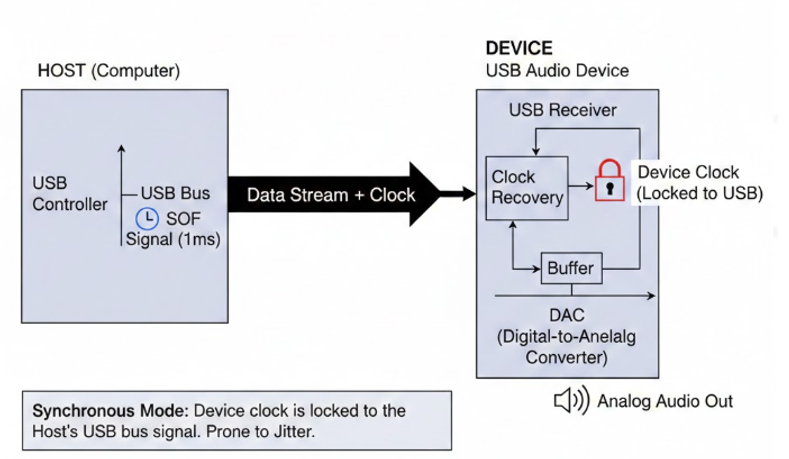
1. Synchronous Mode: Standard for basic USB audio devices
- How it works: The device's clock is locked to the USB bus. It adjusts its sampling rate to match the host's transmission speed.
- Pros: Simple design and low cost.
- Cons: Highly susceptible to USB bus jitter, resulting in mediocre sound quality.
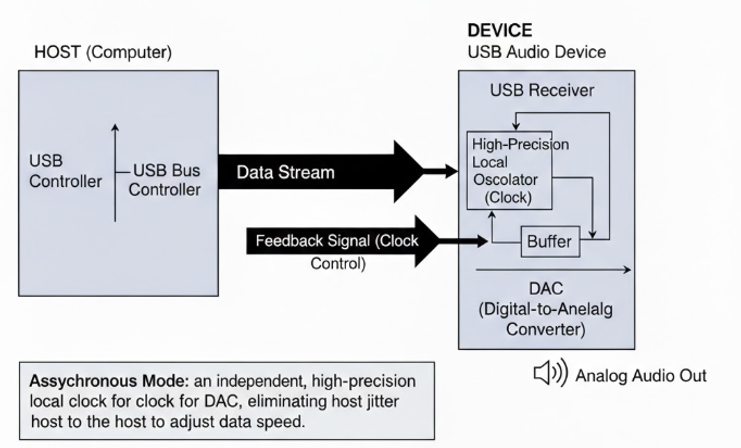
2. Asynchronous Mode : the standard for high-end audio (Hi-Fi DACs)
- How it works: The device uses its own high-precision clock and dictates the data rate to the host via a "Feedback Endpoint."
- Pros: Eliminates USB host jitter for the purest sound.
- Cons: Higher hardware cost and complex firmware development.
3. Adaptive Mode: A middle-ground solution
- How it works: The device adapts to the host’s data stream. It uses a VCXO (Voltage-Controlled Crystal Oscillator) to dynamically adjust its internal sampling rate to match the host.
- Pros: More stable than Synchronous mode; no feedback mechanism required.
- Cons: Still limited by host clock quality; more complex circuit design than Synchronous.
| Comparison | Synchronous | Adaptive | Asynchronous |
| Sync Mechanism | Locked to USB Bus (SOF Signal) | Internal (Follows Host Rate) | Internal (Independent High-Precision Clock) |
| Control by | Host-Driven | Device Passively Adapts to Host Rate | Device-Driven (via Feedback Control) |
| Jitter | Highest (Strongly affected by USB Bus) | Medium (Affected by Host Clock) | Lowest (Determined by Device Hardware) |
| Audio Performance | Poor (Prone to noise floor or harshness) | Fair to Good | Superior (Hi-Fi Standard) |
| Hardware Requirements | Extremely Low | Moderate (Requires clock adjusting circuitry) | High (Requires Precision Clock and Independent Oscillators) |
| Firmware Complexity | Simple | Moderate | Complex (Requires Feedback Mechanism) |
| Applications | Budget Toys, Telephony Headsets | Legacy Sound Cards, General Computer Peripherals | High-End DACs, Professional Recording Interfaces |
C-Media IC Sync Mode Comparison
| Sync Mode | Application | Representative IC |
| Asynchronous | High-Fidelity (Hi-Fi), Gaming, and Hi-Res Products | CM6635, CM6542 |
| Adaptive | Entry-Level & Standard Universal Products | CM108B, HS-100B |
| Synchronous | Legacy or Specialized Industrial Applications | NA |
0
回覆數
392
觀看數
0
收藏數
2026/09/09
18:01 最後回覆
18:01 最後回覆
收藏
喜歡
底部最後回覆 2026/09/09 18:01

