USB Audio: Three Synchronization Types

In USB Audio, the Host (computer) and Device (DAC/Headphones) use independent oscillators, making perfect clock sync difficult. To avoid Buffer Overflow or Underflow (which causes audio glitches), the USB spec defines three Synchronization Types:
1. Synchronous Mode: Standard for basic USB audio devices
- How it works: The device's clock is locked to the USB bus. It adjusts its sampling rate to match the host's transmission speed.
- Pros: Simple design and low cost.
- Cons: Highly susceptible to USB bus jitter, resulting in mediocre sound quality.
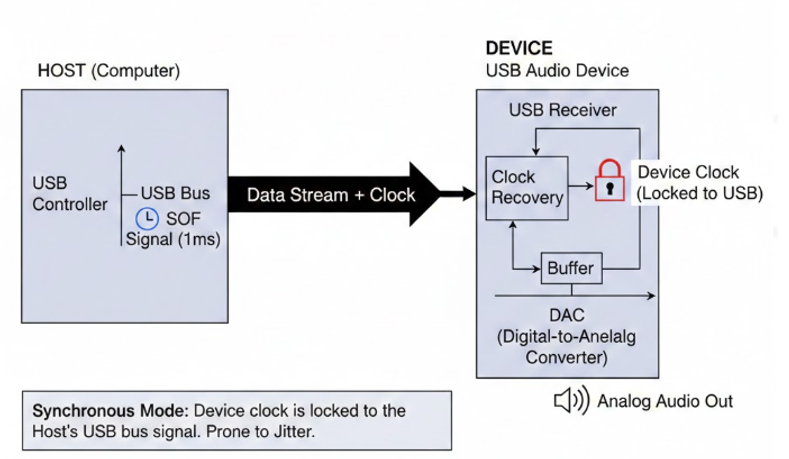
2. Asynchronous Mode : the standard for high-end audio (Hi-Fi DACs)
- How it works: The device uses its own high-precision clock and dictates the data rate to the host via a "Feedback Endpoint."
- Pros: Eliminates USB host jitter for the purest sound.
- Cons: Higher hardware cost and complex firmware development.
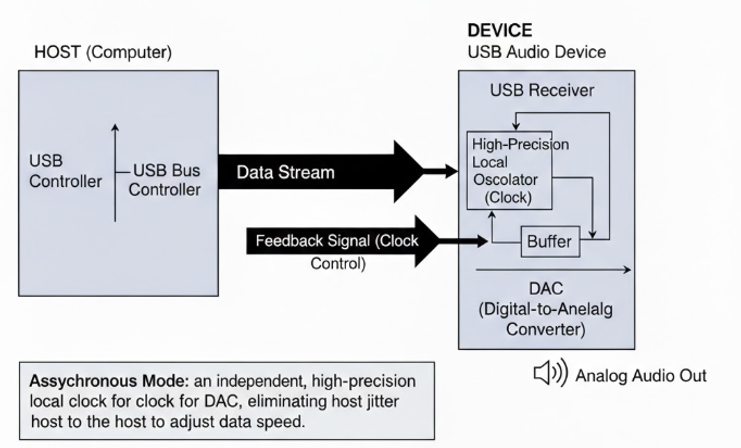
3. Adaptive Mode: A middle-ground solution
- How it works: The device adapts to the host’s data stream. It uses a VCXO (Voltage-Controlled Crystal Oscillator) to dynamically adjust its internal sampling rate to match the host.
- Pros: More stable than Synchronous mode; no feedback mechanism required.
- Cons: Still limited by host clock quality; more complex circuit design than Synchronous.
| Comparison | Synchronous | Adaptive | Asynchronous |
| Sync Mechanism | Locked to USB Bus (SOF Signal) | Internal (Follows Host Rate) | Internal (Independent High-Precision Clock) |
| Control by | Host-Driven | Device Passively Adapts to Host Rate | Device-Driven (via Feedback Control) |
| Jitter | Highest (Strongly affected by USB Bus) | Medium (Affected by Host Clock) | Lowest (Determined by Device Hardware) |
| Audio Performance | Poor (Prone to noise floor or harshness) | Fair to Good | Superior (Hi-Fi Standard) |
| Hardware Requirements | Extremely Low | Moderate (Requires clock adjusting circuitry) | High (Requires Precision Clock and Independent Oscillators) |
| Firmware Complexity | Simple | Moderate | Complex (Requires Feedback Mechanism) |
| Applications | Budget Toys, Telephony Headsets | Legacy Sound Cards, General Computer Peripherals | High-End DACs, Professional Recording Interfaces |
C-Media IC Sync Mode Comparison
| Sync Mode | Application | Representative IC |
| Asynchronous | High-Fidelity (Hi-Fi), Gaming, and Hi-Res Products | CM6635, CM6542 |
| Adaptive | Entry-Level & Standard Universal Products | CM108B, HS-100B |
| Synchronous | Legacy or Specialized Industrial Applications | NA |
18:01 最后回复

This is a really helpful breakdown of USB audio synchronization types. The comparison table makes it easy to understand the differences between synchronous, adaptive, and asynchronous modes. Asynchronous mode definitely seems like the way to go for high-quality audio. When I'm not reading about tech specs, I like to take a break with play jonny . A simple way to relax and enjoy some downtime.
designer prince coat maintains prominence in formal fashion.
Hi, I recently found a great service click here. I really appreciated how convenient everything is. There's a huge selection, navigation is simple, and switching between sections is a snap. Special kudos for how it works on my phone. I use it just as comfortably on my mobile as on my computer, and nothing lags or slows down. For us here in Australia, it's a great option if you want to use a decent, modern platform where everything works reliably and you can have a good time. I highly recommend checking it out.
Starting with Australian platforms, the most valuable impressions often come from ordinary players rather than promotional slogans. People describe whether navigation feels intuitive, whether deposits are processed smoothly, and whether support responds quickly. In many of those threads, Stellar Spins Casino appeared as a platform where these practical aspects were handled consistently. The feedback was calm and realistic, focusing on usability instead of exaggerated claims. That kind of commentary made the site seem like a sensible choice for Australian users who value clarity and reliability.
came across this post while browsing through sports news, and I couldn't agree more with the points made here. These incredible father-and-son stories bring such a unique emotional depth to modern professional sports culture. Whenever big matchdays roll around, tracking team forms and player updates adds so much hype to the overall experience. For enthusiasts living in the Philippines who like staying updated on real-time lines or exploring live betting options, review 1xbet an exceptionally reliable platform with comprehensive coverage. Thanks for sharing this piece!
A Mens Aviator Jacket is one of the easiest ways to bring a bold and confident edge to your winter wardrobe. With its classic design and warm interior, it not only keeps you comfortable in colder weather but also adds a rugged, stylish vibe to your overall look. The best part is how effortlessly it fits into everyday outfits—just pair it with denim and boots, and you’re good to go. It’s a timeless piece that never feels outdated and always manages to stand out without trying too hard.
Thank you for sharing such insightful technical articles on USB audio technology! The integration of voice command capabilities is particularly fascinating, wordle unlimited and it opens doors to enhancing user experiences across various applications.

USB audio synchronization is mainly about keeping the timing of audio data consistent between the host and the device. The three common types—synchronous, adaptive, and asynchronous—differ in how the clock is generated and controlled. Asynchronous USB audio generally gives the device more control over timing, which can help reduce clock-related errors. One practical point is to check the device’s clocking design and driver support when troubleshooting pops, clicks, or timing issues.
sdf
sdf
 回复文章
回复文章 
